

SIGN UP FOR HEALTH AND FITNESS UPDATES
Posted on 10/27/2015 at 6:26:00 AM



I don’t know many (actually any) people who have performed on tour for a Broadway show, had a hit pop single, and worked as a personal trainer. So when I was introduced to Rebecca Miller Tau in New York last month, I was anxious to learn more about her experience. I was particularly interested in whether a relationship exists between the performing arts and fitness. She was kind enough to share her thoughts with me. I’m happy that I am able to share them with our readers.
Rebecca has been a performer her entire life. “When I was two years old, my parents put me in a dance class and from there I never stopped,” she said. She quickly expanded to voice lessons, community theater, and paid performances. She later attended college at Penn State, where she earned a Bachelor of Fine Arts in Musical Theater, which combines acting, dancing, and vocals.
After school, Rebecca earned a role in the ensemble cast of the first National Tour of The Wedding Singer, a Broadway show based on Adam Sandler’s hit movie. In this musical, Rebecca played several roles, including Cyndi Lauper and (for those familiar with Sandler’s work) “the lady with the sideburns.”
Rebecca began to write and record pop music under the recording name BEX. Her first song, Life of the Party, made it onto the top 50 pop charts. This was a big deal for an independent artist competing with musicians backed by large and well-funded record labels. The song was featured in the Nickelodeon movie Fun Size, which included comedians Johnny Knoxville and Chelsea Handler.
Exercise played an important role in Rebecca’s life throughout her diverse performance experiences. “I would just always be in the gym,” she recalled. “I started working with a trainer when my music was coming out. I gained a lot of knowledge about body mechanics and how to fuel my body. I loved it so much, I took a job as a trainer at Rich Barretta Private Training, an exclusive private gym.” At Rich Baretta, Rebecca was around top trainers and athletes, including David Blaine, the self-described endurance artist, who creates illusions using his body.
Rebecca learned about the importance of controlling her body to optimize her performance while acting, dancing, or singing. In an industry that is physically demanding – her music video shoots alone lasted 18 hours a day, according to Rebecca – it is critical to staying healthy and fit. Rebecca employed an exercise routine that she says helped her avoid injury, made her body look “how I wanted it to,” and, perhaps most interestingly, perform at her best.
Although performers like Beyoncé and Justin Timberlake seem to effortlessly sing and dance on stage, a lot of preparation and training go into the fitness component of these elaborate performances.
One area relates to core strength. Rebecca stated, “Strengthening the muscles around the rib cage is really important. When you breathe in and your rib cage expands, you’ve got to create a strong breath that you can use.” She would strengthen her core while training for performances by doing a range of bodyweight exercises, focusing on traditional planks and side planks. Even the act of singing itself works the core. “When you’re practicing singing,” she said, “you don’t even realize how much you’re working out your core, but you are.”
Running around the stage, performing elaborate and synchronized dance moves, and singing are not easy to do simultaneously or sequentially. “No one wants to see someone singing or dancing who looks exhausted and running out of breath,” Rebecca said. There’s an enormous amount of training that goes into the act of breathing. “You always breathe through your mouth as a dancer,” she said. “It’s the quickest way to get air when you need it. You breathe pretty high up, just above the heart.” However, singing requires a different breathing technique: “Your breath needs to come from down low. It needs to be grounded and you need to be very relaxed,” explained Rebecca. The trickiest part is switching between these two very different breathing methods and there’s a lot that goes into practicing exactly when and how one breathes during each performance. And, of course, as Rebecca said, “you need to make it look really easy.”
Today, Rebecca continues to focus her efforts on the performing arts as the founder of Event Music Concierge, a company that matches clients who need performers for special events.
We'd love to hear from you. What do you think about Rebecca’s experience? Comment below or on our Facebook page at facebook.com/flytefitness, or tweet us at @flytefitness.
Be Flyte Fit,
Jeremy Greenberg
Co-Founder & CEO
Flyte Fitness
P.S. DON’T FORGET TO SIGN UP FOR FITNESS UPDATES! CLICK THE BOX AT THE TOP OF THIS PAGE!
Posted on 8/4/2026 at 5:51:00 AM
“It's kind of a catch-22: Strength in women isn't appreciated, and vulnerability in women isn't appreciated. It's like, 'What the hell do you do?' What you do is you don't allow anyone to dictate who you are.” – Actress Jada Pinkett Smith
On Saturday, Serena Williams won Wimbledon in a dominating performance, giving her 21 career Grand Slam singles titles. There has been heated debate by sports talking heads and sports fans alike about Williams’s role as the best female athlete ever, and even the best athlete of either gender of her generation. At age 33, she’s the oldest woman ever to win Wimbledon and shows no signs of slowing down, having won the last four Grand Slam tournaments.
Despite her enormous athletic success, she has faced a different kind of pressure that male athletes nearly never have to endure. Williams has a muscular build, with large triceps, biceps, shoulders, and quads. She is a physical specimen unlike any tennis player ever. She has received criticism for her muscularity, as many deem it non-feminine. In a sport where fashion and looks, rather than talent, often garner the most attention, women’s tennis can place a brutally judgmental spotlight on its participants.
Even though strength and larger muscles may help Williams’s competition get closer to her level, many opt not to bulk up in order to “remain more feminine.” These body image issues are powerful for women at elite levels.
Off-the-court endorsements have made Maria Sharapova, the world’s number two player, the highest-earning female athlete for over a decade. She’s slender and blond. And like many women and girls, she says she wishes she were thinner. Sharapova says, “I always want to be skinnier with less cellulite; I think that’s every girl’s wish.” Sharapova has stated that she avoids weight training.
Agnieszka Radwanska, currently ranked number seven in the world, has over $18 million in career earnings. However, when it comes to becoming stronger, she has declared that looks matter to her and as a result she avoids bulking up. Her coach, Tomasz Wiktorowski, says Radwanska wants to maintain her slim physique because of her perception of a relationship between muscularity and gender, “First of all she’s a woman, and she wants to be a woman.”
I’ve written about the pressure girls and women feel to stay thin. The wow stat that all of us should keep in the front of our minds is that 80 percent of ten-year-old girls have been on a diet. Personal trainer and YouTube workout star Amy Kiser noted in our interview earlier this year that she avoided lifting weights for years because she was so afraid of gaining muscle. Ironically, she blames her avoidance of weight work for keeping her from getting healthy.
Williams is a terrific role model for women and girls. She shows them that it’s beautiful to be strong and healthy. Particularly in a sport in which there is a glass ceiling on physique for women, it’s considered “unsexy” to have muscle by many fans and critics and by players themselves. Unfortunately, Sharapova’s and Radwanska’s perspective is the norm, not the exception. German pro, Andrea Petkovic, says, “I’m self-conscious about what people might say. It’s stupid, but it’s insecurities that every woman has, I think. I definitely have them… I would love to be a confident player that is proud of her body.” Petkovic shudders at seeing photographs displaying herself hitting backhands that show her bulging arm muscles. She says that the pictures make her feel “unfeminine.”
There is clearly a lot of progress yet to be made. Right now, Williams is leading the way towards breaking the glass ceiling that values looks over success. Williams says, “I realized that you really have to learn to accept who you are and love who you are. I’m really happy with my body type, and I’m really proud of it... I talk about it all the time, how it was uncomfortable for someone like me to be in my body.”
We'd love to hear from you. What do you think about the internal and external pressure on female athletes to stay slim? Comment below or on our Facebook page at facebook.com/flytefitness, or tweet us at @flytefitness.
Be Flyte Fit,
Jeremy Greenberg
Co-Founder & CEO
Flyte Fitness
P.S. DON’T FORGET TO SIGN UP FOR FITNESS UPDATES! CLICK THE BOX AT THE TOP OF THIS PAGE!
Posted on 7/14/2015 at 5:35:00 AM

"I think someone should design exercise machines that reward people with sex at the end of their workouts, because people will perform superhuman feats for even the faint hope of that." - Tina Fey
Posted on 6/30/2015 at 4:50:00 AM
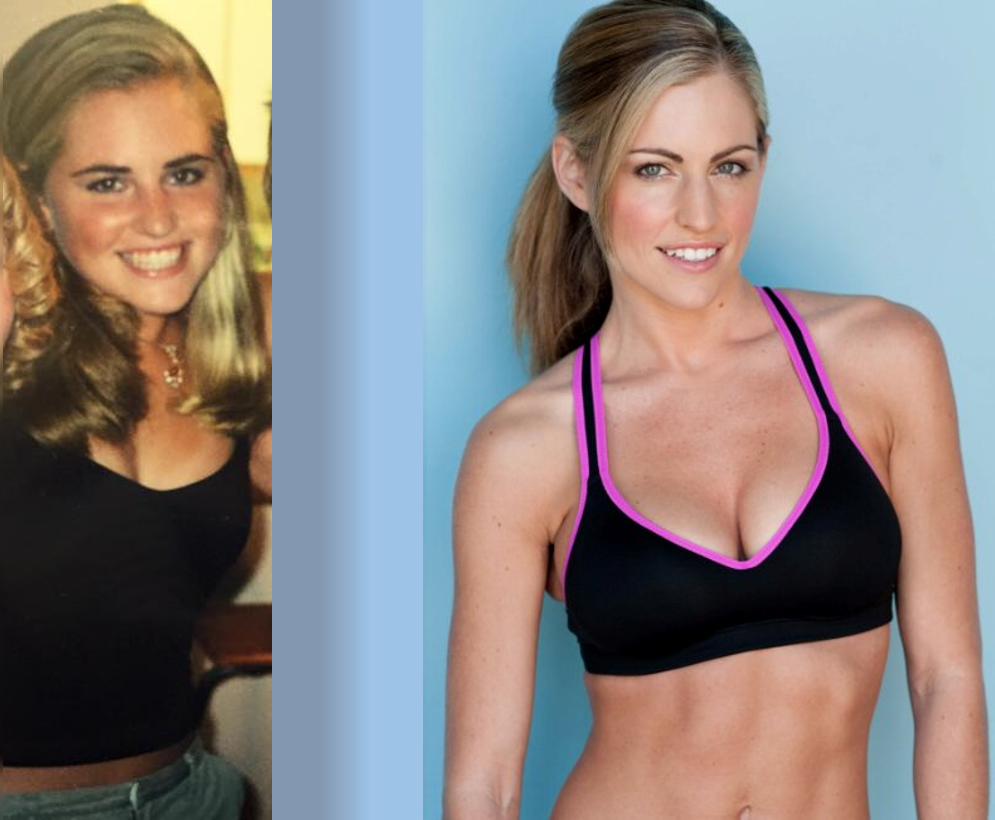
“The experience I had overcoming my weight challenges helped define me." – Amy Kiser, certified personal trainer & fitness instructor
Last week, I had the privilege of speaking with Amy Kiser, a Los Angeles-based certified personal trainer and fitness instructor. Last year, Amy was a top five finalist to become Women's Health Magazine's Next Fitness Star. She just wrapped up a Core Flyte workout video for her Body Fit by Amy YouTube Channel, and I’m excited for you all to check it out – it’s awesome!
We often celebrate fit and attractive trainers like Amy, and act like they are super-human, as if they were molded that way and haven’t had to deal with the day-to-day challenges many of us face battling weight. Amy’s life has not lacked such challenges. It’s safe to say in today’s Instagram / selfie / body image-obsessed culture that all of us are affected by body weight issues. Girls and women, no doubt, are affected the most. A recent Common Sense Media study found that 80 percent of ten-year-old girls have been on a diet. Amy suffered from weight challenges during college and learned from her experience to help improve the lives of others.
Early Years in a Healthy & Active Family
Amy grew up in Marion, Virginia, a small town in the mountains of Virginia. Although Marion didn’t have a gym within a 40-mile radius, Amy grew up in an active family. She recalls, “I always learned that exercise was part of a normal, everyday way of life. It was fun and we liked it.” Amy played sports, danced, ran, and partook in various outdoor adventures with her older sister and younger brother. Her family home was a healthy place, where she ate “something green” with each meal and candy was reserved for special occasions. Exercise, Amy says, “was never a means to an end, like burning calories,” it was for fun. It was part of her active lifestyle.
Battling Weight Gain in College
Amy left her hometown of about 5,000 to attend Virginia Tech in Blacksburg, Virginia, which had built a new gym. Like a lot of college freshmen, Amy put on the “freshman 15,” which then turned into 20, 25, and 30 pounds of additional weight by the end of her first year. What is different about Amy’s case as compared with many college students that battle weight issues is that Amy was working out… a lot. Amy recalls, “I was working out the whole time. I was cycling between trying really strict diets, and over-exercising, and having days where I just didn’t care. It was the first time in my life that I was putting on weight and I just couldn’t understand it. I thought I was doing everything right but I hated my body.”
Amy got into a routine which she refers to as “obsessive,” in which she regularly spent nearly two hours at the gym daily. She was afraid of bulking up, and avoided weight training. Her focus was on cardio… and she did a lot of it. Amy says, “I did a lot of cardio machines and classes at the gym… the treadmill, elliptical, cardio classes...”
She was hard on herself and constantly put pressure on herself to exercise more and more. Amy says, “I felt I had to account for what I was eating. If I felt I had a bad day of eating, I did more cardio. If I missed time at the gym, I felt like I had to make up for it the next day. It was a really bad brain space to be in because everything was negative. I had loved running before and I wasn’t running because I loved it anymore. I was running because I felt I had to do it.”
Intervention: A Turning Point
One day after a two-and-a-half hour long session at the gym, she returned to her dorm and her two roommates, who were (and still are) close friends of hers, confronted her. “They said they were worried about me,” Amy says. “I broke down in tears pretty quickly and told them I was unhappy. I knew I wasn’t living and I wasn’t living a healthy lifestyle. They were very supportive of me and offered to help.” Amy opened up to more friends and her family and sought the help of a counselor on campus. She realized that she was working so hard to lose weight and was being miserable in the process.
Amy credits three specific things to becoming a healthier person. First, she began celebrating her body even though she was overweight. She took pride in running races, including a half marathon. She gradually reduced her negative perception of her body, focusing on her positive accomplishments. Secondly, her diet became more balanced. She shifted from eating highly-processed “diet foods,” such as low-calorie microwave meals and diet soda, to tasty food rich in nutrients. She didn’t punish herself for having a piece of cake or a few drinks at a party. Those were no longer considered indiscretions, but rather part of a “normal life.” Finally, she began strengthening her muscles by performing weight training exercises.
During a summer break later in college, a wellness center affiliated with the local hospital opened up in Amy’s hometown. Amy was an active member of the gym, and was asked to teach a class. Initially unsure, she decided to give it a try and loved it. She became certified in both group fitness and personal training right after college and started her career.
Living a Balanced Lifestyle
Amy says, “The experience I had overcoming my weight challenges helped define me.” Today, Amy keeps photos from her overweight period in her gym spaces for her clients to see. “A lot of people think I was always in great shape,” Amy says, “but that’s not the case. As a trainer, I want people to learn to love their bodies, to be active because it’s fun, healthy, and good for them, and eat well without beating themselves up or depriving themselves. I’m not about quick results or negative reinforcement.”
Thinking positive, cutting yourself breaks, and being balanced are all very important for Amy. Amy says, “If you can’t learn to work out because you love your body and you want to take care of it, you’re not going to see long-term success.”
Battling An-Oft Superficial Industry
Amy is in an industry that can be viewed by many in a very superficial way. It’s a balancing act showing that you can help change bodies without over-emphasizing weight as the most important goal. Amy says, “The number one thing that clients tell me, when I ask what their goals are, is either ‘I want to look better’ or ‘I want to be a certain size.’ My hope is that we can change things and focus more on health.” One way that Amy helps push back against the “looks-focused” goals is by providing her clients with non-weight loss-focused challenges, such as increasing the number of pushups they do or improving their endurance. Not surprisingly, once these goals are met, weight usually follows.
Motivation Through Variety & Options
Amy launched her YouTube channel, which has over 12,000 subscribers. She frequently gets thanked for providing her audience with options and modifications. Amy does so because she believes “everyone is on their own journey.” Unlike her college years when she embraced a “more is better” attitude towards exercise, Amy now says that balance is critical. Discussing her Core Flyte experience, Amy says, “Working out is all about variety and using your muscles in new ways. I’m big on safety and I’m big on form. The Core Flyte gives you more control, better form, and safer movements. Working your body in different planes of motion improves results and it’s fun!” I know you’re all excited to see Amy’s Core Flyte workout video and I hope you enjoy it!
We'd love to hear from you. What do you find most inspiring about Amy’s story? Comment below or on our Facebook page at facebook.com/flytefitness, or tweet us at @flytefitness.
Be Flyte Fit,
Jeremy Greenberg
Co-Founder & CEO
Flyte Fitness
Posted on 5/26/2015 at 9:19:00 AM
"Since I've done Pilates, I'm much better looking and 4 feet taller.” - Rich Beem, Former Professional Golfer
I recently took a Pilates class at my gym. It was the first I had ever taken. We’ve had a lot of Pilates instructors purchase Core Flytes and create classes with them, so I figured I ought to gain a first-hand understanding of what Pilates is all about. I walked in to the class thinking this was going to be a breeze. I walked out humbled and better-educated about the challenges and benefits of Pilates.
Contrary to What Many Think, Pilates is Not Just for Women
“I have been teaching Pilates for 14 years,” says Master Pilates Instructor Johanna Baumbach. “During this time, I have seen a few handfuls of men take advantage of what we can offer. Those who have remained loyal have seen major transformations.” There are many misnomers about Pilates: from “it’s a female thing,” to “it’s too easy,” to “it’s boring.” I’m not sure there’s anything more “manly” than how Pilates began. Joseph Pilates originally created the fitness regimen named after him to train soldiers and police in Europe. He wanted them to have a stronger core, a solid posture, and improved balance and coordination.
Real Men Do Pilates
Olympic champion speed skater Shani Davis incorporates Pilates into his training regimen. Davis recalls his first Pilates session: “The teacher was crazy strong. I was one of only two males and I realized all the ladies were whipping me. My male ego kicked in, I can’t let these ladies beat me. I had a lot of respect for it from that first day—especially as I was sore for a month after that first time.” Muscular athletes and celebrities, including NBA Superstar LeBron James and super-middleweight boxing champ Andre Ward, are Pilates enthusiasts. Rich Beem, winner of the 2002 PGA Championship, said, "Since I've done Pilates, I'm much better looking and 4 feet taller. Seriously, I'm now so stretched out and have such great posture that I look and feel like a different person."
Pilates is All About the Core
There are over 500 formal movements in the Pilates system. These exercises are dedicated to strengthening core muscles. Side effects include improved posture, standing taller, improved concentration, lower stress, reduced back pain, and increased flexibility. As I wrote in a blog a few weeks ago, “the core is a facilitator. It controls the force of other muscles in our bodies.” It is all about control, rather than force. It is no surprise that Joseph Pilates called his method “Contrology,” as it requires one to have control over body mechanics, breathing, and posture. A stronger and more flexible core helps us have this control.
You Don’t Need a Lot of Equipment
It is possible to perform a Pilates workout without any equipment. The class I went to had no equipment and it certainly served its purpose. There are, however, many forms of apparatuses to help facilitate the control and movement required. Smaller forms of equipment used for Pilates include Pilates mats, resistance bands, balance balls, and Core Flytes. Many Pilates classes use large machines known as reformers, which typically cost a few thousand dollars.
No excuses, right? Then give it a try! We'd love to hear from you. Tell us about your experience with Pilates? Comment below or on our Facebook page at facebook.com/flytefitness, or tweet us at @flytefitness.
Be Flyte Fit,
Jeremy Greenberg
Co-Founder & CEO
Flyte Fitness
Posted on 3/31/2015 at 6:31:00 AM
Our society is not blind to gender. From playground stereotypes to unequal pay in the workplace, our views of males and females are different in ways that they ought not be. This is true in the sports and fitness arena as well.
To remind ourselves of how what many perceive to be true often results from irrational cultural norms, here are 5 gender myths:
1. Pink is for Girls
Seems simple, right? Boys wear blue and girls wear pink. That's the way it's always been. Except it hasn't. In fact, pink wasn't considered a "female color" until the 1940s. In 1918, trade publication Earnshaw's Infants' Department said: "The generally accepted rule is pink for the boys, and blue for the girls. The reason is that pink, being a more decided and stronger color, is more suitable for the boy, while blue, which is more delicate and dainty, is prettier for the girl."
2. Cheerleading is Feminine
Presidents Dwight Eisenhower, Franklin Delano Roosevelt, and Ronald Reagan didn't have all that much in common, but each of them was an active cheerleader in college. Women were largely excluded from the sport of cheerleading until the 1960s, as the activity was considered "too masculine" due to the assumption that female participants would develop “unladylike” voices.
3. Girls Can't Play Ball
Mo'ne Davis not only plays with the boys, she dominates them. She's a Little League Baseball pitcher who threw a no-hitter in the Little League World Series at age 13. Last month, while the Major League Baseball season was in full swing, Mo'ne was "the most talked-about baseball player on earth." < The New York Times> Mo'ne was the first Little Leaguer (of either gender) to grace the cover of Sports Illustrated.
4. Women Are Weaker Than Men
The 1973 tennis match in which women's pro Billy Jean King beat retired men’s pro Bobby Riggs in three sets, dubbed the "Battle of the Sexes,", was not an isolated incident in which a female bested a male at sports. Earlier this year, Anthony Adams, a former defensive tackle for the Chicago Bears, "got a lesson in power from strongwoman Kim Baum," according to Muscle & Fitness, when they worked out together. She "kicked his butt" according to reports of the faceoff.
5. Women Don't Watch Sports
A common assumption is that while most men watch sports, women are disinterested. In the U.S., the National Football League is arguably considered the most manly of sports. However, according to Marie Claire, over 45 percent of NFL fans are female.
We hope that dispelling these gender myths was an eye-opening experience for you. We'd love to hear from you. What are some gender misconceptions that you or women you know have proven wrong? Comment on our Facebook page at facebook.com/flytefitness or tweet us at @flytefitness.
Be Flyte Fit,
Jeremy Greenberg
Co-Founder & CEO
Flyte Fitness
Posted on 9/23/2014 at 3:00:00 AM
