
SIGN UP FOR HEALTH AND FITNESS UPDATES
“Nobody goes there anymore. It's too crowded.” - Yogi Berra, baseball legend
Posted on 12/29/2015 at 6:00:00 AM


"Embrace disruption and change early. Don’t react to it decades later. You can’t fight innovation." – Ryan Kavanaugh, film producer and financier
There are many examples of existing industries that have been disrupted to such an extent that incumbents are left flailing as collateral damage. Look for a Blockbuster Video, a Tower Records, a Borders Books, or Circuit City these days and you'll struggle. The wreckage is clear.
We live in a consumer-first era where everything from restaurant delivery (Seamless) to shopping (Amazon) to transportation (Uber) is subject to a choosy and fickle class of consumers.
Disruption in the Fitness Industry
As I've immersed myself more and more in the fitness world, I've realized it's very ripe for disruption on several counts. We have introduced Core Flytes to dramatically change the way we exercise: spend less time, do it where you want and when you want, add fun and creativity, limit stress on your joints, and engage more muscles.
Consumers are often looking for variety, convenience, motivation, and new information when it comes to fitness. Both gyms and trainers are competing for clients, not only with others in their industry, but also with companies that provide home workouts streaming on demand and apps on smartphones. Fitness consumers are empowered and are firmly in control.
The ClassPass Phenomenon
ClassPass (and similar companies) have enabled gym-goers to gain even more leverage. For those unfamiliar, ClassPass offers their members access to a long list of group fitness classes at a long list of gyms. For a fixed monthly price, you can check out the cool spin class one night and the fun dance class the next morning. With the emergence of boutique, highly-specialized studios over the last decade, ClassPass provides the ability to try out the latest craze without a long-term commitment or a steep per-class price.
Instead of paying gyms a membership fee or for a one-off class, ClassPass members pay a monthly fee ranging from $79 in Nashville to $125 in New York. In return, they get access to unlimited fitness classes at local gyms in the ClassPass network. The only exception is a three-class cap preventing members from cherry-picking the most popular gyms by limiting attendance to a specific health club to three times each month.
ClassPass is basically the gym industry's version of Groupon: an aggregator (middle man) is facilitating class sign up and taking a healthy cut of the revenues. As a result, participants pay less and have more variety, while gym memberships are less sticky. Just like those who cut the cable cord because they stream content online, many opt for ClassPass in lieu of a gym membership. It's all about access to service and empowered consumer choice.
Our Experience With ClassPass
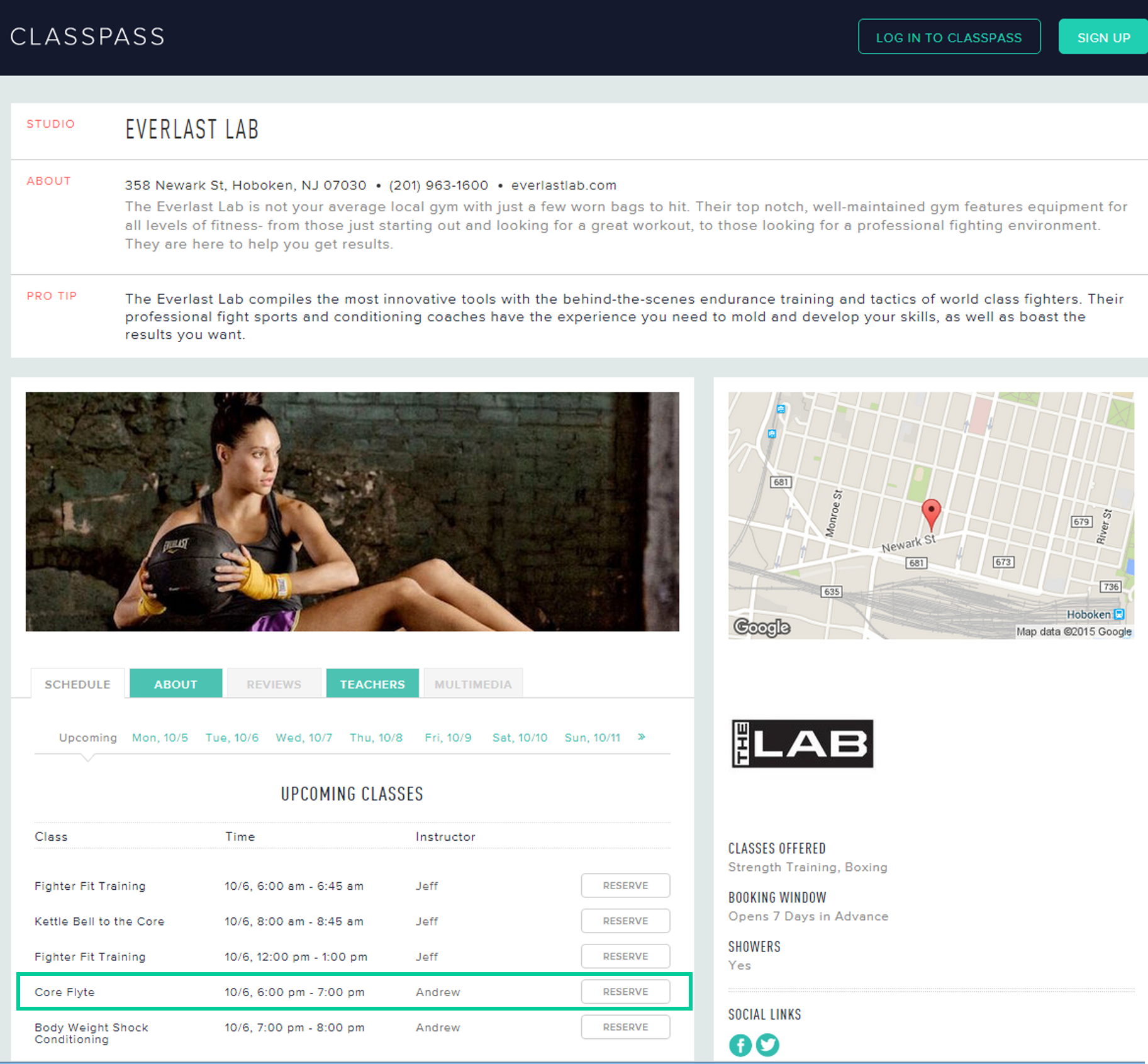
Everlast Lab, the first gym managed by iconic boxing brand Everlast Worldwide in Hoboken, NJ, participates in ClassPass. As a relatively new gym, ClassPass can serve as a mechanism for bringing in new potential clients. The most popular class at the Everlast Lab, according to CEO Neil Morton, is their Core Flyte class that takes place on Tuesday and Thursday nights. This fact, of course, makes me very happy. ClassPass helps facilitate exposure to our awesome Core Flyte classes… and participants love it. Companies like ours, which are in the process of brand-building, benefit from ClassPass because it enables more and more people to be exposed to our products without putting a dent in our bottom line. We’ve had several folks from Everlast Lab decide to purchase Core Flytes after participating in the Core Flyte class.
The Business Model: Winners and Losers
Nearly three years old, ClassPass boasts access to thousands of studios in its network in the U.S. alone. Like the Groupon model, customers get a discounted rate (3-4 studio classes in New York City would cost more than the monthly ClassPass fee) and gyms end up with significantly lower revenue per class (lower net class prices and capture about half of the revenue). The hope (bet) for gyms is that once ClassPass members try their awesome classes, they'll sign up as full-time gym members. Like retailers working with Groupon, this conversion from trial to member does not seem to be happening for studios.
The Importance of a Network Effect and Inevitability of Industry Disruption
Unlike the Groupon retailers who often learn from failed trials, gyms are subject to a massive network effect. If everyone is looking for group fitness experiences on ClassPass, you'd want the gym you manage to participate, right? Just like stores are listed on Yelp, restaurants are listed on Open Table, and manufacturers (including us) are listed on Amazon. The ecosystem is up and gyms feel pressure to be included. It’s the same reason you’re likely on Facebook: everyone else in your social circles (give or take) is on it. Network effects are very hard to create, thus once a company has established one it is very difficult for it to be dismantled.
Even if ClassPass ends up losing out to one of its competitors (e.g., MoveUSA, ClassHopper, etc.) who are essentially doing the same thing, it’s very likely that gyms are in the process of losing control over their members. The reality for most gyms, however, is that the bulk of their revenue does not come from active people looking to try new classes frequently, but rather from those who sign up for gym membership and rarely set foot in the gym (the grand majority). So, the types of health clubs most at risk to the ClassPass phenomenon are smaller boutiques that appeal to passionately-fit individuals.
While the long-term effects of ClassPass and its rivals are unknown, the company’s success points to wavering loyalty for both gyms and specialty group fitness instructors that cannot be ignored.
We'd love to hear from you. How have you used ClassPass as a gym or a member? What are your thoughts on the service and how it may impact the fitness industry? Comment below or on our Facebook page at facebook.com/flytefitness, or tweet us at @flytefitness.
Be Flyte Fit,
Jeremy Greenberg
Co-Founder & CEO
Flyte Fitness
P.S. DON’T FORGET TO SIGN UP FOR FITNESS UPDATES! CLICK THE BOX AT THE TOP OF THIS PAGE!
Posted on 10/4/2026 at 12:00:00 AM

“Every bizarre story in the country now has a Florida connection. I don’t know why, except it must be some inversion of magnetic poles or something.” – Carl Hiaasen, novelist and Floridian
For some reason, a lot of crazy things happen in Florida. And I mean crazy. Only in Florida did we hear of dangling and hanging chads. Only in Florida did a man call 911 over 80 times demanding Kool-Aid, hamburgers, and marijuana. Only in Florida did a man accused of downloading child porn say that his cat did it, not him. Only in Florida did a strip club offer free flu shots. Only in Florida did a woman bite her daughter because she tried to turn off her Rihanna CD.
Posted on 9/1/2026 at 6:46:00 AM

“The money's the same, whether you earn it or scam it." – Bobby “The Brain” Heenan, pro wrestling manager
Gym membership fees vary significantly, depending mostly on where we live and what type of facility we want to work out in. Last year, I wrote about the Manhattan-based Madison Square Club, where an annual membership costs a whopping $26,000 – over 50 times higher than the U.S. average of $492. Members at the posh gym have amenities including their own monogrammed towels, access to elite trainers, and use of state-of-the-art fitness equipment. I think it’s safe to say that most gym experiences fall in the “you get what you pay for” category.
There’s no doubt that anyone who signs up for a pricey health club either thinks long and hard about it or has so much money that the price is trivial for him. So, it was quite shocking when a gym customer in a Hong Kong location of the Physical health club chain recently found out that she was charged the equivalent of $4,900 in fees for a 10-year membership against her will. Four employees of the gym were arrested for allegedly violating Unfair Trade Practice law. If convicted, they each face up to five years imprisonment as well as a hefty fine.
The Hong Kong government is currently investigating over 30 complaints of harassment, coercion, or undue influence related to fitness centers selling their services. Half of the complaints made involve Physical.
According to media reports, the client who lodged the complaint against Physical signed a 10-year membership last year. She was recently prodded by a salesperson to purchase yet another 10-year membership. A witness said, “She had repeatedly told the saleswoman that she was not interested, but the saleswoman continued to harass and persuade her.” The salesperson told the client that she would assist her by looking for a discount, but required her ID and credit card to do so. A few minutes later, the salesperson had charged the client’s card the $4,900 payment without her consent.
Five grand for ten years (or 120 months) of gym membership fees isn’t that bad if you think about it: about $40 per month. However, the lack of consent and a commitment length that rivals a mortgage term is extremely unsettling and illegal.
This incident is a stark reminder that there are sharks out there in the fitness community, just like in any other industry. It’s a shame, since most people are extremely supportive of others as they seek to improve themselves through better nutrition, smarter exercise, and solid lifestyle habits.
We'd love to hear from you. What do you think about this chicanery? Comment below or on our Facebook page at facebook.com/flytefitness, or tweet us at @flytefitness.
Be Flyte Fit,
Jeremy Greenberg
Co-Founder & CEO
Flyte Fitness
P.S. DON’T FORGET TO SIGN UP FOR FITNESS UPDATES! CLICK THE BOX AT THE TOP OF THIS PAGE!
Posted on 8/18/2015 at 3:00:00 AM

I don’t know many (actually any) people who have performed on tour for a Broadway show, had a hit pop single, and worked as a personal trainer. So when I was introduced to Rebecca Miller Tau in New York last month, I was anxious to learn more about her experience. I was particularly interested in whether a relationship exists between the performing arts and fitness. She was kind enough to share her thoughts with me. I’m happy that I am able to share them with our readers.
Rebecca has been a performer her entire life. “When I was two years old, my parents put me in a dance class and from there I never stopped,” she said. She quickly expanded to voice lessons, community theater, and paid performances. She later attended college at Penn State, where she earned a Bachelor of Fine Arts in Musical Theater, which combines acting, dancing, and vocals.
After school, Rebecca earned a role in the ensemble cast of the first National Tour of The Wedding Singer, a Broadway show based on Adam Sandler’s hit movie. In this musical, Rebecca played several roles, including Cyndi Lauper and (for those familiar with Sandler’s work) “the lady with the sideburns.”
Rebecca began to write and record pop music under the recording name BEX. Her first song, Life of the Party, made it onto the top 50 pop charts. This was a big deal for an independent artist competing with musicians backed by large and well-funded record labels. The song was featured in the Nickelodeon movie Fun Size, which included comedians Johnny Knoxville and Chelsea Handler.
Exercise played an important role in Rebecca’s life throughout her diverse performance experiences. “I would just always be in the gym,” she recalled. “I started working with a trainer when my music was coming out. I gained a lot of knowledge about body mechanics and how to fuel my body. I loved it so much, I took a job as a trainer at Rich Barretta Private Training, an exclusive private gym.” At Rich Baretta, Rebecca was around top trainers and athletes, including David Blaine, the self-described endurance artist, who creates illusions using his body.
Rebecca learned about the importance of controlling her body to optimize her performance while acting, dancing, or singing. In an industry that is physically demanding – her music video shoots alone lasted 18 hours a day, according to Rebecca – it is critical to staying healthy and fit. Rebecca employed an exercise routine that she says helped her avoid injury, made her body look “how I wanted it to,” and, perhaps most interestingly, perform at her best.
Although performers like Beyoncé and Justin Timberlake seem to effortlessly sing and dance on stage, a lot of preparation and training go into the fitness component of these elaborate performances.
One area relates to core strength. Rebecca stated, “Strengthening the muscles around the rib cage is really important. When you breathe in and your rib cage expands, you’ve got to create a strong breath that you can use.” She would strengthen her core while training for performances by doing a range of bodyweight exercises, focusing on traditional planks and side planks. Even the act of singing itself works the core. “When you’re practicing singing,” she said, “you don’t even realize how much you’re working out your core, but you are.”
Running around the stage, performing elaborate and synchronized dance moves, and singing are not easy to do simultaneously or sequentially. “No one wants to see someone singing or dancing who looks exhausted and running out of breath,” Rebecca said. There’s an enormous amount of training that goes into the act of breathing. “You always breathe through your mouth as a dancer,” she said. “It’s the quickest way to get air when you need it. You breathe pretty high up, just above the heart.” However, singing requires a different breathing technique: “Your breath needs to come from down low. It needs to be grounded and you need to be very relaxed,” explained Rebecca. The trickiest part is switching between these two very different breathing methods and there’s a lot that goes into practicing exactly when and how one breathes during each performance. And, of course, as Rebecca said, “you need to make it look really easy.”
Today, Rebecca continues to focus her efforts on the performing arts as the founder of Event Music Concierge, a company that matches clients who need performers for special events.
We'd love to hear from you. What do you think about Rebecca’s experience? Comment below or on our Facebook page at facebook.com/flytefitness, or tweet us at @flytefitness.
Be Flyte Fit,
Jeremy Greenberg
Co-Founder & CEO
Flyte Fitness
P.S. DON’T FORGET TO SIGN UP FOR FITNESS UPDATES! CLICK THE BOX AT THE TOP OF THIS PAGE!
Posted on 8/4/2026 at 5:51:00 AM
Core Flytes: Next Generation of Stability Training
For more information, go to our home page or purchase here.
Very portable: Lightweight, durable and easy to store.
For all fitness levels: Adjust the difficulty by using on surfaces with more or less friction or changing the range of motion.
Truly multi-surface: Moves well on any flat surface, including non-slip rubber gym floors, carpet and hardwood.
Inspires creative workouts: Introduces a completely new type of mechanics to popular exercises, and provides a platform for the innovation of new exercises.
Ergonomic design: Works comfortably under hands and feet to give you a full range of movement through all planes of motion.
Innovative technology: Uses patented ball transfer technology inspired by the aeronautics industry to facilitate omni-directional movement.
Wide-range of use: Used by personal trainers, professional athletes, group fitness classes, and physical therapists worldwide.
Each Core Flyte Pro package includes a pair of Core Flytes and a Core Flyte workout poster. Free workout videos are available online.
Posted on 8/3/2026 at 7:35:00 PM

“Reality is a lovely place, but I wouldn’t want to live there." – Adam Young, singer-songwriter
Virtual Reality Isn’t New, And Its Impact Is Gradually Increasing
Virtual reality has been around for a long time. In the mid-19th century, artists created 360-degree murals that wowed observers. In the 1920s, Edwin Link introduced the first flight simulator to train aspiring pilots. In 1957, Morton Heilig invented a device known as the “Sensorama.” The Sensorama was a booth that contained oscillating fans, speakers, mechanisms for emitting smells, and a viewing screen that displayed three-dimensional images. Heilig called this type of entertainment “experience theater.” He was trying to create a new, manipulated reality, one that felt real to the participant but was entirely artificial.
Virtual reality, or “VR,” uses technology to mimic real-life sensory experiences so powerfully that they seem real. Much of the use of VR today is for aeronautics simulation and gaming. Facebook acquired Oculus VR last year for $2 billion, with Facebook’s CEO Mark Zuckerberg proclaiming that “immersive, virtual, and augmented reality will become a part of people’s daily lives.”
Physical Effort Required For Video Games
The Realm is a VR system that puts gamers in a fantasy world, just like any video game console. This, however, is not merely the next generation of the Wii. Users must make a physical effort to progress through the game levels. Want to slaughter that ogre who’s in your way of saving the princess? You need to pick up your virtual axe and swing it with force, at the correct angle, and against resistance you’ll feel. The Realm experience seems real because you’ve got a VR headset on, so any way you turn you see the fantasy world even if for those playing from their parents’ basement. The Realm is set to be released in September, and will include fitness rehab and boxing games among its offerings. Perhaps the stereotype of gamers being Doritos-eating, Mountain Dew-drinking loungers is coming to an end.
Virtual Reality-Inspired Fitness Classes Are Emerging
In Hong Kong’s Pure Fitness studio, they have spin classes that are a bit different than the trendy ones in large U.S. cities. Like any other spin class, there are rows of stationary bikes. Unlike the others, participants are inside a room with a 270-degree screen that surrounds their field of vision. They are part of what’s been deemed “immersive fitness.” The presentation of a visual and auditory experience that can take you away to a different place while you’re working out. It can be daytime during the night, snowy during summer, hilly or flat, smooth or rough terrain, Paris when you’re in Hong Kong, or racing against others when you’re alone. Pure Fitness is planning to expand to other class formats, including yoga, as well. Early morning yoga on the beach will never be so attainable.
Dance With Others When You’re By Yourself
Even Zumba, the monstrously popular dance-focused fitness sensation with over 200,000 locations worldwide, has joined the VR mix. As if 15 million participants isn’t enough, Zumba wants to show potential attendees what the class experience is like even if they can’t make it to a class. Partnering with VR company YouVisit, Zumba is using a 360-degree immersive video to demonstrate what it’s like to be part of the Zumba community. Zumba CEO Alberto Perlman, says, “We tried the VR demo in the office and every guy who put the headset on started dancing, and that never happened with [regular] videos.” People who go to gym classes tend to feel great afterwards. It’s getting to the class (or the gym) that is often the toughest hurdle to overcome. Zumba has expanded classes into a broad range of categories that are geared towards children, older adults, pool settings, and core workouts. In March, I met Perlman and we discussed the possibility of adding Core Flytes to the Zumba suite of classes. For Zumba, fostering a robust exercise community is critical. Abi Mandelbaum, CEO of YouVisit, says, “One thing virtual reality might do is restore a human connection for people who work out at home. VR can help people feel as if they are actually there, with people, doing a fitness activity; this can be a huge motivator. Imagine a virtual reality experience that lets viewers bike in the Tour de France or run the Boston Marathon.”
We'd love to hear from you. How do you think virtual reality will change working out for you? Comment below or on our Facebook page at facebook.com/flytefitness, or tweet us at @flytefitness.
Be Flyte Fit,
Jeremy Greenberg
Co-Founder & CEO
Flyte Fitness
P.S. DON’T FORGET TO SIGN UP FOR FITNESS UPDATES! CLICK THE BOX AT THE TOP OF THIS PAGE!
Posted on 7/7/2025 at 7:49:00 AM

I flew out to Southern California last week to combine a few important goals: spend time with my identical twin brother Ben (see last’s year blog for more on our twin experience), work out with Steve Weatherford – the man considered the fittest player in the NFL (also the subject of an earlier blog), and participate in one of the largest gym industry events of the year. It was quite a week! Oh, and I had to take a red-eye back to run in the NYC half marathon Sunday morning.
Posted on 3/17/2015 at 4:08:00 AM

"My New Year's Resolution list usually starts with the desire to lose between ten and three thousand pounds."
Posted on 12/30/2014 at 6:40:00 AM

I hate the treadmill. I referred to it as the "dreadmill" in a previous blog post because I find it painfully boring to run with no change of scenery except the occasional ebb and flow of fellow treadmillers on either side of me. Upon googling the term "dreadmill," it turns out that I didn't coin the phrase, and I am not alone in my distaste for the stay-in-one-place running device.
Despite our near-universal hatred for the treadmill, it is the most commonly used cardio machine used at the gym, with 40 percent of health club goers using it last year. Lately, treadmill use has been invigorated by innovative group fitness classes.
The Mile High Running Club (MHRC) isn't what you dirty-minded readers may think – or hope – it is. MHRC is New York City's first treadmill running studio, which opened earlier this month. It is one sign of a true treadmill comeback. Equinox launched Precision Running classes on its treadmills in June. Crunch clubs are expanding their Tread N’ Shred classes to get in on the growing trend.
A few weeks ago, in Chile, a shockingly enormous treadmill, measuring three meters wide and six meters long, was used by groups of up to 10 runners at a time for a racing event. Yes, 10 people on one treadmill raced each other.
Back in the U.S., at MHRC, there are 30 treadmills on a spring-loaded, AstroTurf floor. Part of the allure of the new treadmill classes is that they turn an oft-solitary activity into a group experience with support from experts. Debora Warner, MHRC founder, said, “People have been training on their own, in isolation, and without assistance or coaching on the treadmill for so long. I think people want to train smarter."
Most of us are familiar with other boutique group fitness classes, such as SoulCycle, barre method, and rowing machine classes. Thumping music and a hyper-energized environment are key to these classes. At the treadmill classes, however, there is no music at all. The programs are creatively structured to keep participants on their toes. In a class entitled "Good Cop, Bad Cop," the instructor dictates the treadmill incline, alternating between flat ("good cop") and steep ("bad cop").
The benefits of training on a treadmill -- even for hardcore marathon runners -- include: racking up mileage on a low-impact surface to reduce the chance of injury, running in close proximity with others despite speed variances, staying warm during frigid winter weather, accurately pacing and performing interval training, and motivation and feedback from an expert coach.
I hope you enjoyed learning about these new treadmill classes. We'd love to hear from you. What do you do while you're on the treadmill to help time fly by? Comment on our Facebook page at facebook.com/flytefitness or tweet us at @flytefitness.
Be Flyte Fit,
Jeremy Greenberg
Co-Founder & CEO
Flyte Fitness
Posted on 11/25/2014 at 5:13:00 AM