
SIGN UP FOR HEALTH AND FITNESS UPDATES
"One important key to success is self-confidence. An important key to self-confidence is preparation." - Arthur Ashe
Today, I’m writing the second article in our monthly series, “Taking Flyte," showcasing friend and partner Steve Weatherford’s advice on topics relating to health, fitness, and wellness. Last month, Steve reflected on the ups and downs of 2015. Today, Steve shares his thoughts on how he prepares to perform at his best: before, during, and after a big event.
There’s no bigger event for a professional football player than the Super Bowl. Steve shared how he mentally prepared throughout his experience with the New York Giants in Super Bowl XLVI. The Giants won 21-17 over the New England Patriots and Steve played a pivotal role, pinning three punts within the Patriots' 20-yard line (two within the 10-yard line) which created field position havoc for the opposition. So, how did he mentally prepare for the biggest event of his life? We asked him.
Entering the Super Bowl, how did you mentally prepare for the big event?
Weatherford: “You treat it like anything else. I draw my confidence from knowing that I did every single possible thing up to that point to prepare myself for that one moment to be the greatest in the world. It's not that I had to go do yoga and find my Zen. For me, hard, hard, hard freaking work in the off-season is where I get my confidence.”
I’ve seen this hard work first-hand myself. We discussed how he prepared for the Super Bowl while we worked out in a marathon session that included an intense Core Flyte workout and what he calls “ARMageddon,” an all-out assault on every area of the tricep and bicep muscles. My arms felt like jelly for a couple of days after!
You’re playing in the Super Bowl. The stakes are high. How did you stay mentally focused?
Weatherford: “Nobody was having more fun in that game than I did. I was celebrating. I was hopping around. I was having fun. I was giggling. I know that you're only as good as your next play. For me, my first punt at the Super Bowl led to two points for us [a safety on Pats superstar Tom Brady]. That's as good as it gets for a punter. It's about being excited that you did well and then letting that go and focusing on the next play. Same thing if you had a bad one. If you have a bad one you let that go… short-term memory is key.”
Steve reminds those of us who know him that you can perform at a high level and have fun at the same time: they are not mutually exclusive. The important thing is to focus on your role and execute well each step of the way. In fact, for many people, having fun helps them stay loose – especially in a high-pressure situation – which can improve performance.
You won the Super Bowl. How did you mentally absorb such a big win?
Weatherford: “It’s important to celebrate. If you asked me before the game, ‘How many beers would have after you won the Super Bowl?’ I would have told you ‘all of them!’ But after the Super Bowl, I’m not kidding you, I went to the Super Bowl post-party and there were celebrities everywhere and everyone is partying and having a good time… but I had one drink, a Jack and Coke. I drank that drink and I looked at my wife and said, ‘I don’t want to feel any different. I’m not drinking anymore.’ With the euphoria that came from a lifetime of preparation to achieve a lifetime goal, I didn’t want to feel any different. I didn’t need alcohol to feel any different. I had just one drink. I enjoyed the celebration for about three hours with my mom, my dad, my in-laws, my son, and my daughter. I ended up going to bed around two in the morning. That was earlier than every single one of my teammates.”
Steve is a fun guy. His energy is insane. At the Super Bowl, he was as excited as anyone. At the end of the day, however, he was able to keep the achievement in perspective and enjoy it for what it was: the pinnacle of athletic accomplishment. And he did it with his family, which now includes two more children. And who knows… maybe while he was celebrating he was secretly thinking about his next workout!
We’d love to hear from you. How do you mentally prepare for a big event? Comment below or on our Facebook page or tweet us at @flytefitness.
Be Flyte Fit,
Jeremy Greenberg
Co-Founder & CEO
Flyte Fitness
P.S. DON’T FORGET TO SIGN UP FOR FITNESS UPDATES! CLICK THE BOX AT THE TOP OF THIS PAGE!
Posted on 1/19/2016 at 10:06:00 AM


"Measure twice, cut once." - Proverb
Although one might fall into the trap of thinking that athletes are meat-heads who don't think, the reality is quite the opposite. Performing well requires focusing on numbers and math. Ask any athlete about the metrics she measures and she’ll spew off a litany of detailed numbers: amount of weight lifted, number of reps performed, number of sets completed, distance ran, minutes or seconds in each training interval, hours of sleep, glasses of water consumed, macronutrient percentages, and on and on.
Measurement is a critical requirement for making progress. If we don't know how we are performing, we can't assess what's working or not working, or how (or whether) we are moving forward towards re...
Read morePosted on 1/12/2025 at 5:55:00 AM
“Every new beginning comes from some other beginning's end.” - Seneca, philosopher
Like most people on the planet, I’m sure you saw Star Wars: The Force Awakens this weekend. Predictably, the movie broke box office records and attracted several generations of Star Wars fans to the theaters dressed as their favorite characters. It was the seventh movie in the franchise, appropriately named “Episode VII.”
We are about to embark on a new ritual for this blog. As we turn the page on 2015, we will begin to share more insight from our partner Steve Weatherford. Steve is a Super Bowl champion, father of four, philanthropist, fitness maniac, health buff, and a relentlessly fashion-conscious man. He’s a lover ...
Read morePosted on 12/22/2015 at 9:37:00 AM
“The Navy looked after me like my mother. It fed me, took care of me and gave me wonderful opportunities.” - Actor Tony Curtis
Posted on 12/15/2015 at 4:35:00 AM

“Never make predictions, especially about the future.” - Casey Stengel, Major League Baseball outfielder and manager
It's now November. Whoa! Where has the year gone? As we replace the pumpkin and ghost decorations with turkey ones, we are one step closer to the end of 2015. It's been an exciting year for us at Flyte Fitness. We began selling our Core Flyte stability training tools and customers, fitness professionals, and distribution partners all gave us excellent feedback. As the year comes to an end, we are looking forward to a great 2016.
So, what's in store for fitness next year? Last week, the American College of Sports Medicine (ACSM), the largest sports medicine and exercise science organization in the world, gave us its annual predictions. ACSM published the results of its fitness trend forecast for 2016.
2,800 survey respondents –worldwide health and fitness professionals – differentiated "fads" (think Pizza Rat) from "trends" (think brick oven pizza) and focused on the areas that they think will influence the way that individuals will behave in the foreseeable future.
Here are the top five fitness trends for 2016 predicted by experts:
1. Wearable technology
Requirements: Cool tech gadgets
This trend went from “never-ranked” in the top 20, to “top-of-the-list.” The most common wearables used today are activity trackers that count steps walked, estimate heart rate and calories burned, and count hours of sleep. Many of these are integrated with smartphones and apps. There are wristbands (Fitbit), watches (Apple Watch), spectacles (Google Glass), and even earrings (we wrote about these last year).
The survey's lead author Walter Thompson, Associate Dean of the College of Education & Human Development at Georgia State University, said wearable technology helps by "gauging the intensity of effort during the workout... [and] also provides motivation between workouts."
We have written extensively about the importance of motivation and accountability when it comes up exercise. Technology that accurately monitors activity with little support required by users helps us see when we succeed and when we fall behind in clear, objective, and quantifiable metrics. I'm all for tools that help us track progress, and if they look cool too, great.
2. Body Weight Training
Requirement: Body.
The top trend in last year's survey, body weight training, took runner-up for 2016. Most personal trainers, group fitness classes, and popular home workout programs include body weight exercises that require only one's body. I was happy to see fitness professionals continue to recognize this trend as Core Flyte exercises take body weight exercises like planks, lunges, squats, push-ups, and rollouts to the next level.
3. High-Intensity Interval Training (HIIT)
Requirement: Clock.
High-intensity interval training (HIIT), HIIT, is considered an effective method for getting a limit-pushing workout in a short period of time. It is comprised of alternating bursts of activity (e.g., sprints) and brief periods of recovery. It can be used with both cardio and strength exercises. Our Everlast Lab Core Flyte class has a session consisting of HIIT with 45-60 seconds of all-out Core Flyte exercises alternating with short rest periods.
4. Strength Training
Requirement: Weights.
Strength training uses resistance in order to build muscle and anaerobic endurance. It typically involves the use of equipment such as free weights. This type of training evokes the nostalgia of the movie Pumping Iron, but is certainly not only for the body-building type. Many women shy away from using weights due to fear of getting "too bulky." This is an unfounded fear because using weights is a great way to tone muscles and build strength and does not create a bulky look for most women.
5. Educated, Certified & Experienced Fitness Professionals
Requirement: Knowledge.
Ignorance may be bliss, but when it comes to exercise, it stunts progress, leads to inefficient workouts, and causes injuries. Knowledgeable fitness professionals help set and establish best practices and find innovative ways to work out. Attending fitness conventions in LA, New York, Orlando, and Atlanta this year has broadened my awareness of just how many new types of educational formats are out there, and how many are coming. Fitness professionals will have new ways to expand their tool sets with each new exercise science course. And, yes, we have in the works a Core Flyte education course for fitness professionals!
We’d love to hear from you. Is the prediction for wearables overstated? Which trend do you think will be the most important in 2016? Comment below or on our Facebook page at facebook.com/flytefitness or tweet us at @flytefitness.
Be Flyte Fit,
Jeremy Greenberg
Co-Founder & CEO
Flyte Fitness
P.S. DON’T FORGET TO SIGN UP FOR FITNESS UPDATES! CLICK THE BOX AT THE TOP OF THIS PAGE!
Posted on 11/3/2026 at 12:30:00 AM

The average career for NFL players is astonishingly short: 3.3 years overall and 4.9 years for kickers and punters. It's easy for those of us watching professional football players on TV, in a stadium, or through the lens of fantasy football points to miss the fact that these well-trained athletes are human. We put them on a pedestal when they succeed and we trash them when they don't perform well.
March, I met John Carney while I was working out with our Flyte Fitness partner Steve Weatherford in Southern California at John’s gym, Carney Training Facility. John and Steve were using Core Flyte stability trainers to train themselves, their NFL friends, and John’s clients. My first impression of John was that he is incredibly humble, very knowledgeable in exercise techniques, and open-minded with a thirst for learning and improving.
John Carney, now 51 years young, has a lot to be proud of. He is one of the most celebrated kickers in NFL history. He has 2,062 points scored (fifth in NFL history), played 23 seasons in the NFL, is one of two NFL players in history with four decades of active play, and was the oldest ever to play in a Pro Bowl at age 44.
Last week, John and I spoke about his NFL experience, his training program for kickers and punters, and his philosophy on fitness and longevity.
An Unlikely Road to the NFL
Growing up in Palm Beach, Florida, John loved soccer and played on his high school’s soccer team. Despite his passion for soccer, football was calling him. John recalled, “If you were a male at our high school, it was expected that you would try out for the team.” He initially tried out as a wide receiver, but felt that his soccer experience plus “a little bit of work” would get him on the field as a kicker and a punter.
John went to a kicking camp in Fort Lauderdale led by NFL kicking star Garo Yepremian. He made the junior varsity team as a kicker and a punter his sophomore year. Then, he played on the varsity squad his junior and senior years.
And that's where his football career nearly ended. John said, “I never really planned on playing football after high school. I wanted to play collegiate soccer, but I didn’t receive a lot of phone calls for soccer.”
John walked on to the football team at Notre Dame, which was his father's favorite school. Notre Dame had then, and still has now, one of the most competitive and storied programs in all of college football. John followed fellow high school teammate Alonzo Jefferson, Florida’s all-time leading rusher at the time, to the Golden Dome.
As a freshman at Notre Dame, John made the traveling team as the kickoff specialist. He proceeded to earn the field goal duties his sophomore through senior seasons. It was an exciting experience for John: “I loved the challenge to kick against exceptional programs like USC, Penn State, and Miami,” he said.
John had an outstanding career at Notre Dame. His 51 field goals remain the most in history. Despite John’s talent and track record, it wasn't easy for him to make it into the NFL. He went undrafted and it took him three years to break through and make an active NFL roster for the regular season. Reflecting back, John said, “The long road paid off. I had an opportunity to work my craft and get better and stronger and more serious about becoming an NFL placekicker.”
Posted on 10/13/2015 at 12:19:00 AM
"Embrace disruption and change early. Don’t react to it decades later. You can’t fight innovation." – Ryan Kavanaugh, film producer and financier
There are many examples of existing industries that have been disrupted to such an extent that incumbents are left flailing as collateral damage. Look for a Blockbuster Video, a Tower Records, a Borders Books, or Circuit City these days and you'll struggle. The wreckage is clear.
We live in a consumer-first era where everything from restaurant delivery (Seamless) to shopping (Amazon) to transportation (Uber) is subject to a choosy and fickle class of consumers.
Disruption in the Fitness Industry
As I've immersed myself more and more in the fitness world, I've realized it's very ripe for disruption on several counts. We have introduced Core Flytes to dramatically change the way we exercise: spend less time, do it where you want and when you want, add fun and creativity, limit stress on your joints, and engage more muscles.
Consumers are often looking for variety, convenience, motivation, and new information when it comes to fitness. Both gyms and trainers are competing for clients, not only with others in their industry, but also with companies that provide home workouts streaming on demand and apps on smartphones. Fitness consumers are empowered and are firmly in control.
The ClassPass Phenomenon
ClassPass (and similar companies) have enabled gym-goers to gain even more leverage. For those unfamiliar, ClassPass offers their members access to a long list of group fitness classes at a long list of gyms. For a fixed monthly price, you can check out the cool spin class one night and the fun dance class the next morning. With the emergence of boutique, highly-specialized studios over the last decade, ClassPass provides the ability to try out the latest craze without a long-term commitment or a steep per-class price.
Instead of paying gyms a membership fee or for a one-off class, ClassPass members pay a monthly fee ranging from $79 in Nashville to $125 in New York. In return, they get access to unlimited fitness classes at local gyms in the ClassPass network. The only exception is a three-class cap preventing members from cherry-picking the most popular gyms by limiting attendance to a specific health club to three times each month.
ClassPass is basically the gym industry's version of Groupon: an aggregator (middle man) is facilitating class sign up and taking a healthy cut of the revenues. As a result, participants pay less and have more variety, while gym memberships are less sticky. Just like those who cut the cable cord because they stream content online, many opt for ClassPass in lieu of a gym membership. It's all about access to service and empowered consumer choice.
Our Experience With ClassPass
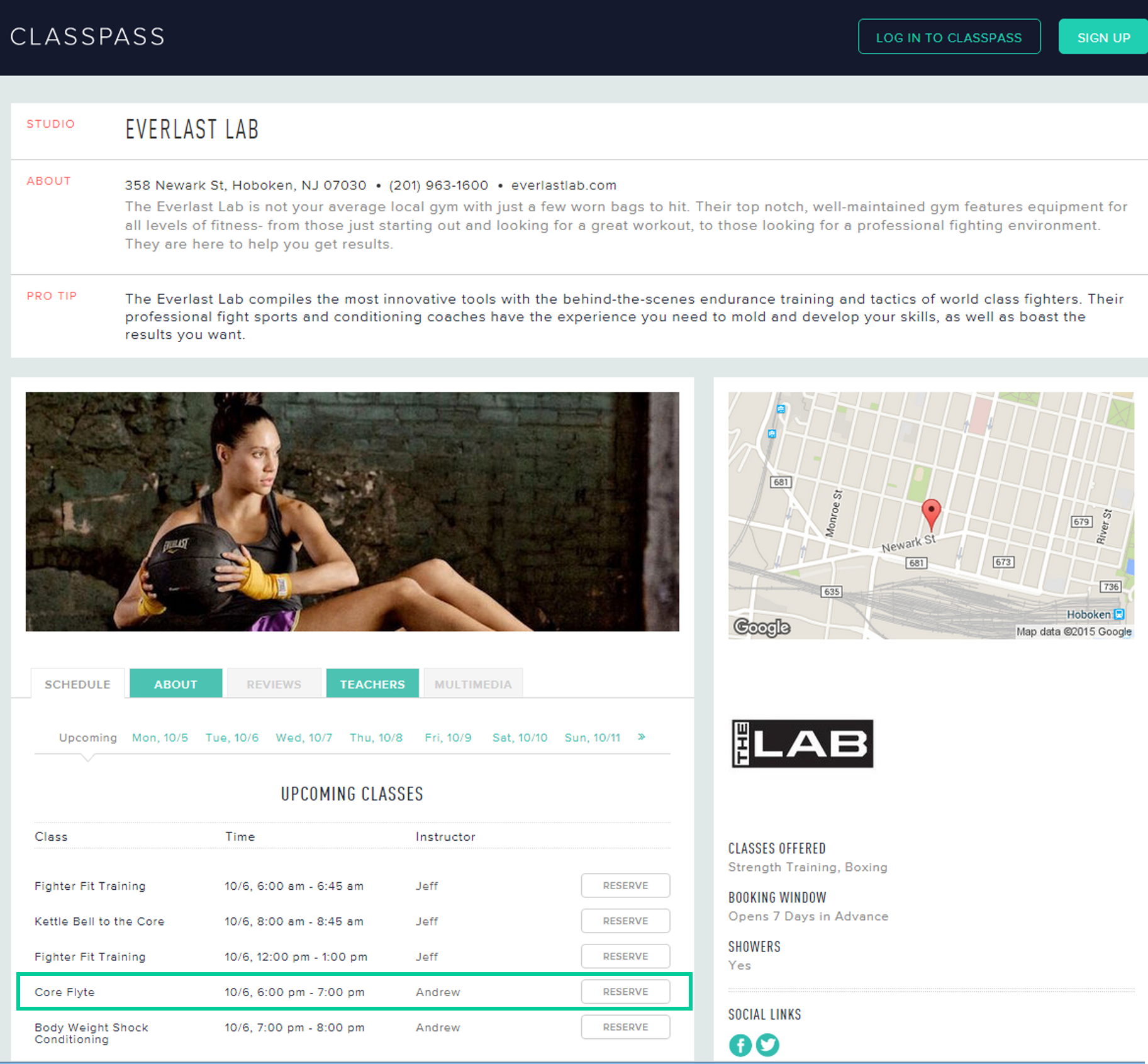
Everlast Lab, the first gym managed by iconic boxing brand Everlast Worldwide in Hoboken, NJ, participates in ClassPass. As a relatively new gym, ClassPass can serve as a mechanism for bringing in new potential clients. The most popular class at the Everlast Lab, according to CEO Neil Morton, is their Core Flyte class that takes place on Tuesday and Thursday nights. This fact, of course, makes me very happy. ClassPass helps facilitate exposure to our awesome Core Flyte classes… and participants love it. Companies like ours, which are in the process of brand-building, benefit from ClassPass because it enables more and more people to be exposed to our products without putting a dent in our bottom line. We’ve had several folks from Everlast Lab decide to purchase Core Flytes after participating in the Core Flyte class.
The Business Model: Winners and Losers
Nearly three years old, ClassPass boasts access to thousands of studios in its network in the U.S. alone. Like the Groupon model, customers get a discounted rate (3-4 studio classes in New York City would cost more than the monthly ClassPass fee) and gyms end up with significantly lower revenue per class (lower net class prices and capture about half of the revenue). The hope (bet) for gyms is that once ClassPass members try their awesome classes, they'll sign up as full-time gym members. Like retailers working with Groupon, this conversion from trial to member does not seem to be happening for studios.
The Importance of a Network Effect and Inevitability of Industry Disruption
Unlike the Groupon retailers who often learn from failed trials, gyms are subject to a massive network effect. If everyone is looking for group fitness experiences on ClassPass, you'd want the gym you manage to participate, right? Just like stores are listed on Yelp, restaurants are listed on Open Table, and manufacturers (including us) are listed on Amazon. The ecosystem is up and gyms feel pressure to be included. It’s the same reason you’re likely on Facebook: everyone else in your social circles (give or take) is on it. Network effects are very hard to create, thus once a company has established one it is very difficult for it to be dismantled.
Even if ClassPass ends up losing out to one of its competitors (e.g., MoveUSA, ClassHopper, etc.) who are essentially doing the same thing, it’s very likely that gyms are in the process of losing control over their members. The reality for most gyms, however, is that the bulk of their revenue does not come from active people looking to try new classes frequently, but rather from those who sign up for gym membership and rarely set foot in the gym (the grand majority). So, the types of health clubs most at risk to the ClassPass phenomenon are smaller boutiques that appeal to passionately-fit individuals.
While the long-term effects of ClassPass and its rivals are unknown, the company’s success points to wavering loyalty for both gyms and specialty group fitness instructors that cannot be ignored.
We'd love to hear from you. How have you used ClassPass as a gym or a member? What are your thoughts on the service and how it may impact the fitness industry? Comment below or on our Facebook page at facebook.com/flytefitness, or tweet us at @flytefitness.
Be Flyte Fit,
Jeremy Greenberg
Co-Founder & CEO
Flyte Fitness
P.S. DON’T FORGET TO SIGN UP FOR FITNESS UPDATES! CLICK THE BOX AT THE TOP OF THIS PAGE!
Posted on 10/4/2026 at 12:00:00 AM

I don’t know many (actually any) people who have performed on tour for a Broadway show, had a hit pop single, and worked as a personal trainer. So when I was introduced to Rebecca Miller Tau in New York last month, I was anxious to learn more about her experience. I was particularly interested in whether a relationship exists between the performing arts and fitness. She was kind enough to share her thoughts with me. I’m happy that I am able to share them with our readers.
Rebecca has been a performer her entire life. “When I was two years old, my parents put me in a dance class and from there I never stopped,” she said. She quickly expanded to voice lessons, community theater, and paid performances. She later attended college at Penn State, where she earned a Bachelor of Fine Arts in Musical Theater, which combines acting, dancing, and vocals.
After school, Rebecca earned a role in the ensemble cast of the first National Tour of The Wedding Singer, a Broadway show based on Adam Sandler’s hit movie. In this musical, Rebecca played several roles, including Cyndi Lauper and (for those familiar with Sandler’s work) “the lady with the sideburns.”
Rebecca began to write and record pop music under the recording name BEX. Her first song, Life of the Party, made it onto the top 50 pop charts. This was a big deal for an independent artist competing with musicians backed by large and well-funded record labels. The song was featured in the Nickelodeon movie Fun Size, which included comedians Johnny Knoxville and Chelsea Handler.
Exercise played an important role in Rebecca’s life throughout her diverse performance experiences. “I would just always be in the gym,” she recalled. “I started working with a trainer when my music was coming out. I gained a lot of knowledge about body mechanics and how to fuel my body. I loved it so much, I took a job as a trainer at Rich Barretta Private Training, an exclusive private gym.” At Rich Baretta, Rebecca was around top trainers and athletes, including David Blaine, the self-described endurance artist, who creates illusions using his body.
Rebecca learned about the importance of controlling her body to optimize her performance while acting, dancing, or singing. In an industry that is physically demanding – her music video shoots alone lasted 18 hours a day, according to Rebecca – it is critical to staying healthy and fit. Rebecca employed an exercise routine that she says helped her avoid injury, made her body look “how I wanted it to,” and, perhaps most interestingly, perform at her best.
Although performers like Beyoncé and Justin Timberlake seem to effortlessly sing and dance on stage, a lot of preparation and training go into the fitness component of these elaborate performances.
One area relates to core strength. Rebecca stated, “Strengthening the muscles around the rib cage is really important. When you breathe in and your rib cage expands, you’ve got to create a strong breath that you can use.” She would strengthen her core while training for performances by doing a range of bodyweight exercises, focusing on traditional planks and side planks. Even the act of singing itself works the core. “When you’re practicing singing,” she said, “you don’t even realize how much you’re working out your core, but you are.”
Running around the stage, performing elaborate and synchronized dance moves, and singing are not easy to do simultaneously or sequentially. “No one wants to see someone singing or dancing who looks exhausted and running out of breath,” Rebecca said. There’s an enormous amount of training that goes into the act of breathing. “You always breathe through your mouth as a dancer,” she said. “It’s the quickest way to get air when you need it. You breathe pretty high up, just above the heart.” However, singing requires a different breathing technique: “Your breath needs to come from down low. It needs to be grounded and you need to be very relaxed,” explained Rebecca. The trickiest part is switching between these two very different breathing methods and there’s a lot that goes into practicing exactly when and how one breathes during each performance. And, of course, as Rebecca said, “you need to make it look really easy.”
Today, Rebecca continues to focus her efforts on the performing arts as the founder of Event Music Concierge, a company that matches clients who need performers for special events.
We'd love to hear from you. What do you think about Rebecca’s experience? Comment below or on our Facebook page at facebook.com/flytefitness, or tweet us at @flytefitness.
Be Flyte Fit,
Jeremy Greenberg
Co-Founder & CEO
Flyte Fitness
P.S. DON’T FORGET TO SIGN UP FOR FITNESS UPDATES! CLICK THE BOX AT THE TOP OF THIS PAGE!
Posted on 8/4/2026 at 5:51:00 AM
Core Flytes: Next Generation of Stability Training
For more information, go to our home page or purchase here.
Very portable: Lightweight, durable and easy to store.
For all fitness levels: Adjust the difficulty by using on surfaces with more or less friction or changing the range of motion.
Truly multi-surface: Moves well on any flat surface, including non-slip rubber gym floors, carpet and hardwood.
Inspires creative workouts: Introduces a completely new type of mechanics to popular exercises, and provides a platform for the innovation of new exercises.
Ergonomic design: Works comfortably under hands and feet to give you a full range of movement through all planes of motion.
Innovative technology: Uses patented ball transfer technology inspired by the aeronautics industry to facilitate omni-directional movement.
Wide-range of use: Used by personal trainers, professional athletes, group fitness classes, and physical therapists worldwide.
Each Core Flyte Pro package includes a pair of Core Flytes and a Core Flyte workout poster. Free workout videos are available online.
Posted on 8/3/2026 at 7:35:00 PM
Core Flyte Plank Pike: Exercise of the Week
Watch this Core Flyte Plank Pike video to see how Core Flytes transform traditional floor exercises into creative, stability workouts. Core Flytes are the next generation of ball stability training, activating the core and engaging more muscles for a full-body workout. Core Flytes are portable stability trainers designed to roll with you, with three balls that roll under a stable base. Core Flytes are used by personal trainers, professional athletes, group fitness classes, and physical therapists worldwide. The NFL's fittest man, Super Bowl champion Steve Weatherford, demonstrates.
For more workout videos, click here or go to the Workouts tab on our website.
Always warm-up and stretch before performing any exercises. Consult the safety and warning instructions that accompany your Core Flytes before using.
Posted on 7/20/2015 at 1:51:00 PM